
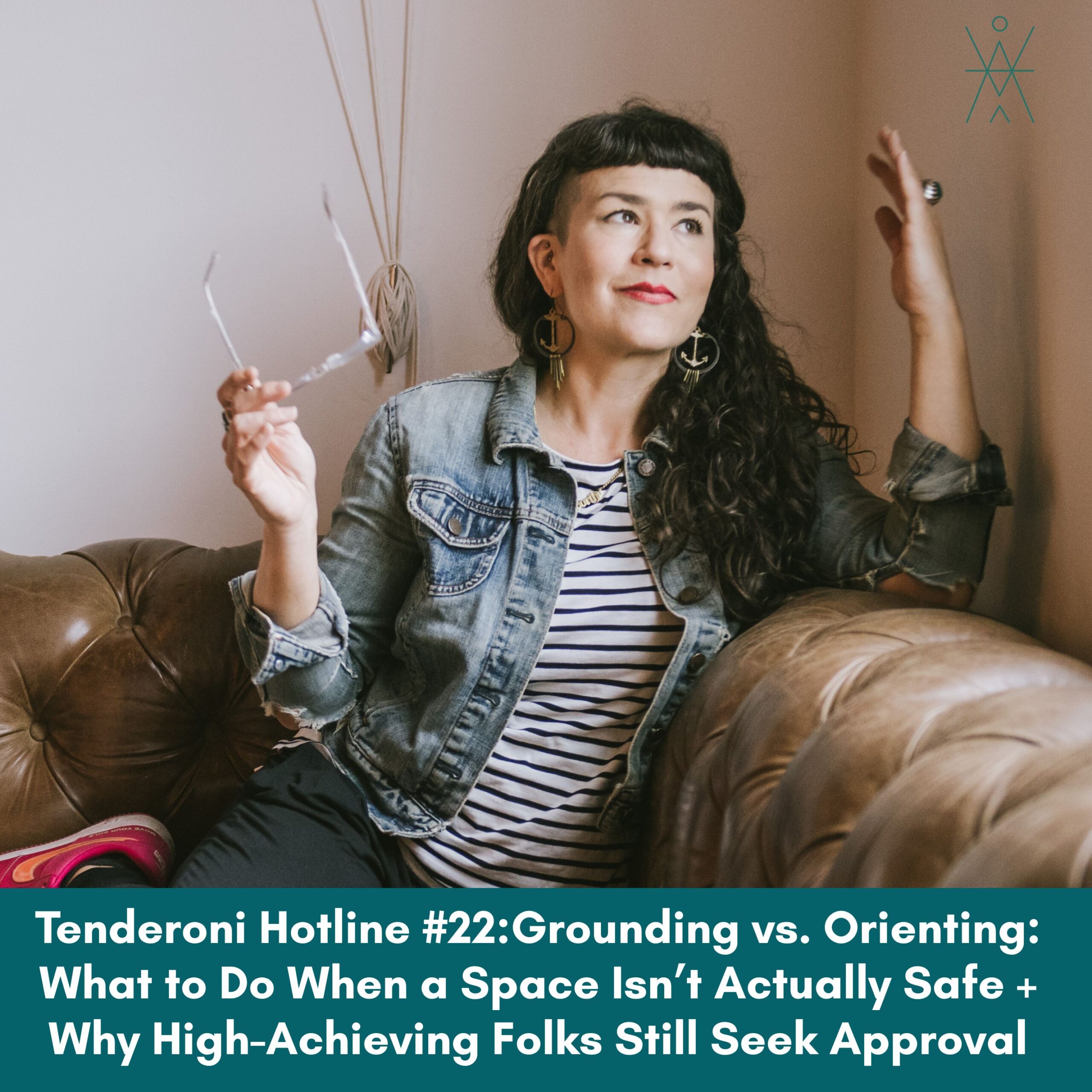
Tenderoni Hotline #22: Grounding vs. Orienting: What to Do When a Space Isn’t Actually Safe + Why High-Achieving Folks Still Seek Approval
Welcome back to the Tenderoni Hotline, our warm and cozy corner of The Feminist Wellness Podcast, where we talk nervous system healing, somatic tools, and reclaiming your self-worth, one question at a time. If you've got something tender on your heart and want my support, write to me at podcast@beatrizalbina.com and I’ll answer you in a future episode. Let’s dive in.
How to Feel Safe in an Unsafe World
You’ve heard it before:
“Just ground yourself.”
“Take a breath.”
“Regulate.”
As if feeling safe is something you can simply decide to do.
As if your nervous system should be calm while the world feels unstable.
And if you’re queer.
If you’re BIPOC.
If your existence is politicized.
“Just calm down” can feel like a dismissal, not support.
So let’s get honest.
Grounding does not make unsafe spaces safe.
But it can help you stay connected to yourself so you can move through them more safely.
And that distinction matters.
What Does It Actually Mean to Feel Safe?
Before we go further, we need clarity.
Feeling safe is not the same as feeling calm.
Calm is a state.
Safety is a nervous system assessment.
Your nervous system is constantly asking:
Am I safe right now?
It answers that question by scanning:
- The environment
- The people around you
- Your past experiences
- Subtle cues of threat or belonging
So when someone tells you to “feel safe,” what they often mean is “be less activated.”
But activation is not dysfunction.
Sometimes activation is accurate.
Grounding Does Not Make Unsafe Spaces Safe
Let’s separate two practices that often get blurred together.
Orienting is gathering information.
Grounding is anchoring in the present moment.
Orienting asks:
- What is actually happening here?
- Who is in this room?
- Where are the exits?
- What is my body picking up on?
In spaces that hold real risk, orienting might look like:
- Noticing symbols, language, tone shifts.
- Mapping how to leave quickly.
- Deciding whether being visible feels safe or strategic.
- Tracking whether your body feels more guarded or more open.
That is not paranoia.
That is your nervous system trying to keep you safe.
Grounding in those spaces may need to be subtle:
- Feeling your feet inside your shoes.
- Tracking the wall behind you.
- Holding your phone or keys and noticing their weight.
- Letting your breath be natural instead of forcing it deep.
You are not grounding to feel calm.
You are grounding so you do not collapse, fawn, or dissociate when you need to respond.
Regulation is not about serenity.
It is about maintaining access to choice.
And choice increases safety.
Hypervigilance and Safety
For many marginalized folks, hypervigilance has been protective.
It has helped people stay safe.
So somatic work is not about eliminating vigilance.
It is about making it conscious so it becomes less exhausting.
Instead of unconscious scanning that drains you, we move toward intentional orienting that supports you.
And here is where emotional outsourcing often shows up.
Your body says this does not feel safe.
The room says you are overreacting.
Suddenly you question yourself.
- Am I too sensitive?
- Am I misreading this?
- Should I just relax?
But safety is not determined by consensus.
Safety is determined by your nervous system’s assessment.
Your discomfort is data.
Your fear is information.
Your activation may be telling the truth.
You Cannot Force Yourself to Feel Safe
You cannot breathe your way into structural justice.
You cannot manifest safety in a room that is actively hostile.
Expecting people to feel safe in unsafe conditions is unjust.
What is possible is building capacity.
Capacity to:
- Stay connected to yourself.
- Notice when something is not safe.
- Leave earlier.
- Ask for support.
- Regulate after exposure to stress.
Grounding does not magically create safety.
It helps you stay present enough to move toward greater safety.
That is a powerful shift.
Why You Don’t Feel Safe Centering Yourself
You built the career.
You are respected.
You are competent.
You are accomplished.
And yet you do not feel safe trusting your own judgment.
You wait to be chosen.
Approved.
Reassured.
You are exhausted by it.
This is not a character flaw.
It is a nervous system pattern.
How We Learned What Was Safe
Very few of us were explicitly told our worth was conditional.
What happened was relational.
We learned through:
- Who received warmth.
- Which emotions were welcomed.
- What made caregivers soften.
- What caused withdrawal.
Over thousands of moments, your nervous system mapped:
Connection equals safety.
So you became excellent at staying connected.
You read the room.
You anticipated needs.
You managed tension.
Especially under patriarchy and capitalism, where women are rewarded for being useful and chosen.
Being wanted felt safe.
Being authentic sometimes did not.
And for many high achieving women, the same traits that built success also trained the nervous system to equate self centering with risk.
So when you try to prioritize your own needs, your body does not feel safe.
Guilt rises.
Shame rises.
Fear rises.
Not because you are selfish.
Because your system associates self prioritization with relational danger.
Self Trust Requires Feeling Safe in Your Own Body
Self trust is not an affirmation.
It is a nervous system experience.
It is built through repeated moments where:
You choose yourself.
And you remain safe.
If you never had experiences of being safe while centering yourself, your body will resist it.
So we start small.
Three Tiny Ways to Practice Feeling Safe With Yourself
Not dramatic change.
Just awareness.
1. Notice What You Actually Want
When you get into bed, ask yourself:
What temperature feels good to me?
You do not have to change anything.
Just notice.
That is practicing internal safety.
2. Observe the Urge to Justify
When someone asks what you are doing, notice if you minimize or inflate your answer to seem more acceptable.
You do not have to change your response.
Just notice the impulse.
You are building safety in self awareness.
3. Pause After Eating
Ask yourself:
Am I done because I am full?
Or because everyone else finished?
Or because I feel guilty?
Again, no forced behavior change.
Just gathering data.
Safety grows when your body learns it can have preferences without losing connection.
The Through Line
Whether we are talking about political landscapes
or professional women who cannot trust themselves,
The core question is the same.
What makes you feel safe?
Grounding does not guarantee safety.
Success does not guarantee safety.
External validation does not guarantee safety.
Safety is built when your nervous system learns:
I can stay connected to myself.
I can notice what is not safe.
I can act in my own best interest.
And I will survive doing so.
Final Thoughts
Whether we are talking about political landscapes
or professional women who cannot trust themselves,
The core question is the same.
What makes you feel safe?
Grounding does not guarantee safety.
Success does not guarantee safety.
External validation does not guarantee safety.
Safety is built when your nervous system learns:
I can stay connected to myself.
I can notice what is not safe.
I can act in my own best interest.
And I will survive doing so.
Want to Go Deeper?
Grab your copy of End Emotional Outsourcing to learn how to stop performing safety and start actually feeling it.
You will get real tools, somatic practices, and feminist coaching support to help you come home to yourself, one nervous-system-loving step at a time.
And if you want my free orienting audio and grounding meditations to support your daily practice, head here to get your free downloads.
My 12-week programs include live teaching, guided somatic practices, journaling workbooks, and a private podcast where I answer your questions directly. Learn more here.
Tags: emotions, trauma, hips, nervous system, somatic healing, stored trauma, emotional regulation, trauma release, wellness myths, feminist wellness, embodied healing