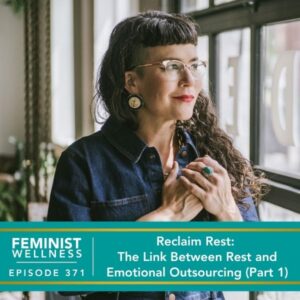
Ep #371: Reclaim Rest: The Link Between Rest and Emotional Outsourcing (Part 1)
Do you feel like you’re constantly running on empty, struggling to find space for rest while the world around you keeps demanding more? It’s a common experience, and it’s often the result of emotional outsourcing. But what if rest could be the key to reclaiming your energy, your values, and your connection to what matters most?
In this episode, I’m diving into the concept of rest as an essential practice, not just for recharging, but for healing. Rest is often misunderstood as a luxury, but it’s a vital part of maintaining our physical, emotional, and mental well-being, and for equipping ourselves to show up fully for the things we care about, especially in a world that constantly asks for more.
Tune in this week to learn why rest feels so hard to access for many of us and how it connects to emotional outsourcing. We’ll also talk about why rest isn’t selfish, how it can improve your relationships, and the different types of rest that are vital to integrate into your life.
My book, End Emotional Outsourcing: How to Overcome Your Codependent, Perfectionist, and People-Pleasing Habits is here! This book is your practical, science-backed, loving guide to finally stop handing your emotional life over to other people and stop taking theirs on for them. Order yours today by clicking here!
Key Takeaways & Timestamps:
[00:00] – The Exhaustion of Emotional Outsourcing
How managing others' emotions leads to burnout and how it impacts your ability to rest.
[02:43] – The Fear of Rest
Why rest feels threatening for some, and how our nervous system links stillness with danger.
[06:32] – Types of Rest
Exploring physical, mental, emotional, sensory, social, and spiritual rest, and why all of them are important.
[10:20] – Rest in Small Steps
How to start integrating rest into your life, even when it feels impossible.
[12:30] – The Power of Rest to Reconnect You with Your Purpose
Understanding that rest isn't just about physical recovery; it's about restoring your emotional and mental resilience to continue the work that matters.
Listen to the Full Episode:
Episodes Related to Reclaiming Rest:
• Ep #103: Meditation Doesn't Work for Everyone
• Ep #105: Buffering vs. Conscious Distraction
• Ep #360: Who Are You Without Emotional Outsourcing Habits?
Featured on the Show:
• Grab my free suite of meditations and nervous system exercises here!
• If you have not yet followed, rated, and reviewed the show on Apple Podcasts, or shared it on your social media, I would be so grateful and delighted if you could do so!
• Join me in my group coaching program, Anchored: Overcoming Codependency
• Come join us in The Embodied Learning Lab!
• Get your copy (or 10) of my book, End Emotional Outsourcing!
Full Episode Transcript:
This is Feminist Wellness, and I’m your host, Nurse Practitioner, somatics and nervous system nerd, and life coach Béa Victoria Albina. I’ll show you how to get unstuck, drop the anxiety, perfectionism, and codependency so you can live from your beautiful heart. Welcome, my love, let’s get started.
Hello, hello, my love. I hope this finds you doing so well. My darling, one of the most common things I read in reviewing applications to Anchored, my six-month coaching and somatics program, is a deep and pervasive sense of exhaustion. And sure, we can blame the patriarchy and late-stage capitalism, along with white supremacy and hustle culture, for sure. We can blame the invisible labor load on women and fems, and we can, for sure, point a finger at emotional outsourcing.
My darling, the horrors persist, and we're just freaking wiped out. But it's not anything new for us. If you've spent years emotionally outsourcing, chronically and habitually sourcing your sense of safety, belonging, and worth from everyone and everything outside yourself instead of from within, leaving deep in those codependent perfectionist and people-pleasing habits, your body has learned to read rest as a threat. So most of us have been exhausted since jump. And we need to talk about rest.
And listen, I don't mean the kind that comes like wrapped in $300 pajamas or like spa weekends that somehow leave you more exhausted than when you started. I mean the kind of rest that makes your nervous system go, "Oh. Oh, okay. So this is what safety feels like."
Here's what I know. Your system figured this out early. Staying in motion, staying useful, staying ahead of everyone's needs was how you felt safe. Maybe you were the kid who kept the peace. Maybe love only showed up when you were achieving. Maybe stillness meant you could finally hear all the tension you were trying to outrun. So your smart, brilliant, amazing body learned, movement equals safety. Looking busy? They can't come for me. Rest equals risk. And now, now rest can bring up anxiety, guilt, even panic, stir your whole nervous system up. When you slow down, there's suddenly space for everything you've been managing and controlling and don't look behind that curtain. Suddenly, it catches up.
Your nervous system doesn't know the difference yet between I'm resting, but like truly, truly, truly resting, and I'm in danger. It just knows that stillness used to mean that something bad was maybe coming. The body can't heal without rest. You can't come home to yourself if the house lights never get dimmed. And yet, we fear it. We fear that if we stop, we'll never start again, that we'll dissolve into the couch, binge Netflix until our eyeballs fall out, lose whatever edge we've been clutching.
But here's the thing. That fear isn't about laziness. Lazy doesn't exist. It's puritanical BS designed to measure your worth in units of productivity. What's real is a nervous system that's been running at full capacity for decades. And when it finally gets a whiff of safety, it collapses. This is where presence becomes your best friend.
Presence helps you tell the difference between true rest and buffering, those little ways we numb out from what hurts. And we went into a ton of detail about buffering and defined terms and all of that in episodes 14 and 105. That was a really long time ago. Buffering is a huge part of what we do. Okay. So it's really presence that helps you to know, am I actually resting? Is this actually fulfilling and supportive and making my life better? Am I just numbing out?
And sometimes your system only has the bandwidth for what I call conscious distraction. Episode 105 details it, and that's okay. Sometimes it's ready and available for deep rest, and the noticing is what matters. The compassion and care and curiosity around whatever's true. And then there's the fear of being seen resting. Ooh, that bone-deep pressure to look busy, to prove you're useful, to never appear idle. That didn't come from nowhere.
If you grew up in a family or culture or religion where visibility without productivity got you dismissed, mocked, negated, worse, your body learned that stillness was dangerous, because maybe it was. And maybe praise only came when you were achieving. Maybe love arrived through performance. Maybe you watched what happened to people who slowed down. Your smart nervous system took notes.
So movement, doing, became synonymous with safety and rest. Rest started to feel like a tightrope walk without a net. My beauty, there are so many ways to rest, and each one feeds something different that emotional outsourcing depletes. Let's go through them.
Physical rest is the nap you don't apologize for, the stretch before bed, that moment when you finally feel your jaw unclench for the first time in months. It can be passive, sleeping, lying down, full-body stillness, or gently active, like a slow walk or gentle yoga that lets your fascia remember how to soften.
Sensory rest is turning down the volume on everything coming at you. Dimming the lights, putting the phone face down, eating a meal in actual silence instead of with the TV screaming in the background. It's giving your overstimulated system permission to really receive less. It's putting your phone not just face down but all the way in a drawer or in the other room, because studies show that if you can see your phone, it's distracting you. Isn't that wild? So putting it all the way out of sight so it can actually be out of mind, and your mind can actually rest without it pulling your attention.
At night here at home, our light bulbs, when the sun goes down, switch from white to red. The red bulbs go on. They're on little timers. It's nothing complicated. It's like a couple bucks at your local family-owned independent hardware store. It's a way we give ourselves sensory rest every evening, and we sleep a lot better.
Mental rest is when the 17 tabs in your brain finally close one by one. For those of us who've lived in hypervigilance, ooh, this can feel so weird, so weird, so weird. Your brain doesn't know what to do if it's not like tracking everyone's moods and micro-expressions and like, are they having fun? Are they happy? Are they mad at me?
Over time, your mind learns slowly but steadily that stillness won't kill you. Not tracking everyone can actually be okay. We talked about this in episode 360 or about the beautiful things that are on the other side of emotional outsourcing. You get to actually be present in your own life through this sort of rest.
It can also look like gardening, knitting, crochet, washing dishes slowly, anything repetitive that lets your thoughts loosen their death grip. We talked about mindfulness as a pathway in episode 103. Meditation doesn't work for everyone. It's a good one. Check it out.
Emotional rest happens when you stop managing everyone else's feelings and finally let your own exist. It's that like deep sigh that escapes when you finally stop pretending to be fine. It's the radical honesty of saying, I cannot hold it all today, so I'm going to stop trying.
So emotional rest is permission to be a whole messy human without packaging yourself for anyone's comfort and against anyone's discomfort. This is one of the many things that is so healing about being in Anchored. It's this space where you really truly can just show up as just yourself. And you don't have to manage anyone else's experience of you, because everyone at Anchored is there to be seen, to be loved, to be cared for, and to be real, to be authentic. This kind of rest is vital, this emotional rest. And most of us don't have a place for it. And so that's what Anchored offers is a place to actually emotionally rest, to put down the burden of trying to manage how you show up so everyone else is comfortable. It's a beautiful gift.
Social rest is the exhale that comes from choosing connection that actually nourishes you. It's the evening you say no to small talk and yes to being alone, or no to small talk and yes to deep convos only, or to sitting beside someone who doesn't need you to fill every silence. It's freedom from the performance of being liked.
Creative rest brings your sense of wonder back online. It happens when you stop producing and start receiving beauty. So letting a song move through you, watching the clouds shift, letting color and form wash over you without needing to analyze or understand it. When your worth isn't welded to your output, creativity gets to be play again.
Spiritual rest is reconnecting with the bigger web, prayer, ritual, community, standing under trees, and remembering you belong to something vast and ancient. Emotional outsourcing tells us we must earn belonging. Spiritual rest lets you remember you're made of stardust and you were born with it.
And often, several kinds of rest happen at once. When I volunteer at the food bank, that's social rest because I adore those people, mental rest because I'm not analyzing or performing, I'm just showing up. Spiritual and social rest because I feel woven into something greater than my own small life.
When Ziggy Stardog, our old dog was with us, I would take these slow walks with him. He was ancient. And so that was physical rest through gentle movement, mental rest because I'm not planning or catastrophizing, sensory rest because I'm outside in nature with actual air and light instead of blue screens.
Cooking a simple meal can hold multiple kinds of rest. Creative rest when you play with flavor, emotional rest when you cook just for yourself, sensory rest when you slow down enough to smell, taste, and actually feel the texture of everything. Hands in the soil working a garden, that's spiritual rest as you meet the earth, our Pachamama, physical rest as your body softens, creative rest as color and texture fill your senses.
Even lying in bed listening to rain can bring sensory, emotional, and spiritual rest all at once. Your nervous system remembering that the world keeps its own rhythm even when you stop holding everything up. These moments rebuild the scaffolding that emotional outsourcing wears thin. Rest shifts your survival mode towards safety mode. It teaches your body that life keeps going when you're not white-knuckling the steering wheel, that the world doesn't collapse when you take your hands off.
You begin to trust stillness and in that, trust yourself. Now beauty, I know what you might be thinking. Okay, B, this all sounds lovely, but how do I actually do this when rest makes me want to crawl out of my skin?
Okay, so if rest feels completely unreachable right now, start with kitten steps. Ten seconds. One minute. Close your eyes. Feel your body's weight in the chair. Turn off the overhead lights and light a candle. Or step outside and find one green thing to look at. You don't need to call it a practice yet. Just notice what happens inside you when you stop performing. That's where rest begins.
In part two, I'll give you the practical stuff, how to figure out which type of rest you need right now, specific practices you can try today, and what to do when rest brings up all that anxiety and guilt and desire to jump out of your skin and wash all the windows and repaint the cat and like do things. Because my beauty, rest isn't something you earn by finishing the list. Rest is the reminder that you're already enough, already whole, already worthy of belonging even when you're still, even when you're not doing a single gosh darn thing. You are not your productivity. You are a perfect, perfect animal. And you get to take tender care of yourself.
Thank you for being here, my darling. I appreciate you. I'm grateful you're here. I don't want you to miss part two, so make sure that you're following or subscribed to the show. If you got a moment between resting and you could leave me a five-star rating and review for the podcast, and hey, why not one for End Emotional Outsourcing as well? It really helps us smaller creators, smaller writers, folks who don't have a huge PR budget. We really depend on you, the folks who are listening to, reading, growing from this work. You help us to get our work out into the world because the way algorithms work these days, ratings and reviews are the thing that makes a thing, a thing that people know about.
So, I thank you in advance for leaving your ratings and reviews, both for the Feminist Wellness podcast and for End Emotional Outsourcing: How to Overcome Your Codependent, Perfectionist, and People-Pleasing Habits. I appreciate you. I'm so glad you're here. Take gentle care of you. I'll see you next week for part two. But for now, let's do what we do. Gentle hand on your heart, should you feel so moved, and remember, you are safe. You are held. You are loved. And when one of us heals, we help heal the world. Be well, my beauty. I'll talk to you soon. Ciao, ciao.
Enjoy the Show?
• Don’t miss an episode, listen and follow on Apple Podcasts, Spotify, or RSS.
• Leave a review in Apple Podcasts.
• Join the conversation by leaving a comment below!