Ep #356: Questions Not to Ask at the Holiday Table
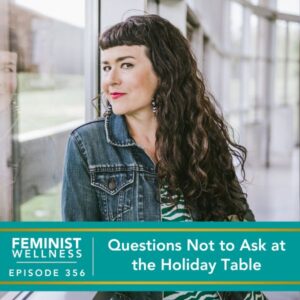
Does the thought of holiday gatherings make your chest tighten? Maybe you're the one who always accidentally says the wrong thing. Or maybe you're the one fielding invasive questions about your relationship status, body, or life choices for the 473rd time. Either way, you're not alone.
In this episode, I'm addressing something that happens at every family gathering: those seemingly innocent questions that assume everyone wants the same milestones, and that life happens in some neat and tidy order. Questions about marriage, kids, weight, work, and why you're still single - they often land like judgment even when they come from a loving place.
Tune in this week as I lay out the worst holiday table questions (and what to ask instead), and exact scripts for responding to invasive questions without starting a gravy boat war. You’ll also learn how to stay grounded when someone crosses your boundaries, and five connection-building questions that actually bring people closer.
12 Days to End Emotional Outsourcing is my free, live daily program that I’m teaching from December 15th, 2025 to the 26th. This is where you’ll learn how to help your nervous system stop scanning everyone else so you can start hearing you again. Save your spot here.
Key Takeaways & Timestamps:
[00:00] – Introduction to Holiday Table Questions
Béa introduces the theme of the episode: navigating tricky holiday table questions with love, compassion, and grounded responses.
[04:00] – How to Handle "When Are You Getting Married?" or "When Are You Having Kids?"
How these questions can land as judgment and how to respond with curiosity that honors people’s boundaries and experiences.
[09:00] – Managing Comments on Body Weight and Appearance
Body comments are often unhelpful and can be triggering for some; learn how to shift focus from appearance to presence and kindness.
[12:00] – Responding to "Why Are You Still Single?"
Instead of defending yourself, how to calmly set a boundary with grace and own your choices with confidence.
[15:00] – Handling Questions About Work and Career
How to reframe the common “What do you do?” question to focus on hobbies, well-being, and personal joy outside of work.
[18:00] – Dealing with "When Are You Moving Back Home?"
How questions about proximity and family can evoke guilt, and how to respond with grace while protecting your peace.
[22:00] – Handling Therapy or Healing Questions
Responding to questions about your healing journey in a way that asserts boundaries and celebrates self-care without defense.
[25:00] – Shifting to Positive, Connection-Building Questions
Five great questions to ask that build connection and reduce stress, including “What’s been feeling good for you lately?” and “What’s been keeping you grounded?”
Listen to the Full Episode:
Episodes Related to Questions Not to Ask at the Holiday Table:
Featured on the Show:
• Download my free orienting exercise by clicking here!
• If you have not yet followed, rated, and reviewed the show on Apple Podcasts, or shared it on your social media, I would be so grateful and delighted if you could do so!
• Join me in my group coaching program, Anchored: Overcoming Codependency
• Come join us in The Embodied Learning Lab!
• Get your copy (or 10) of my book, End Emotional Outsourcing!
Full Episode Transcript:
This is Feminist Wellness, and I’m your host, Nurse Practitioner, somatics and nervous system nerd, and life coach Béa Victoria Albina. I’ll show you how to get unstuck, drop the anxiety, perfectionism, and codependency so you can live from your beautiful heart. Welcome, my love, let’s get started.
Hello, hello, my love. I hope this finds you doing so well. So, this week, we are talking about the worst questions to ask at the holiday table. And this episode is for two kinds of people, and maybe you, my tender love, are both, depending on the day.
First, it's for all my tender hearts who struggle with what I so lovingly call a foot-in-mouth disease. You know who you are. You walk into a holiday gathering with the best intention, and somehow, without meaning to, you say the one thing that makes your cousin's face do that like collapsed tight smile thing. And you didn't mean harm. You just haven't been given the right language yet. So you're listening today because you want to do better. You want to show up in community in the most loving, kindest, most bestest ways, and I'm here to support you to do just that.
It's also for all my tender, sweet squash blossoms who end up on the receiving end, chronically or just here and there, but still the ones who leave dinners feeling like wrung out because someone asked the one question that hit too close to home for the 473rd time. You'll get something either way because I'm going to share two things that matter most in this work that we do together. One, how to use your words, what to actually say when something lands wrong or crosses a limit or a boundary or just feels terrible. Two, how to use your body, that somatic ninja skill of staying centered and grounded.
Not pretending you're like, I'm above being triggered. No, come on, that's not healing. That's not healing. We don't do positive vibes only kind of baloney here. All vibes. Only all vibes, right? Being above being triggered, being like more spiritual than thou and not admitting you have like human feelings is not healing. It's disconnection.
So what we're learning is to be less easily activated and to stay present with ourselves when we are. So to take a breath, to stay grounded and present and say, "Wow, what an interesting thing to say out loud," instead of losing your footing and your mind. So, if the holidays tend to turn your body into a stress ball or your mouth into a liability, either way, my sweet one, you are in the right place.
So let's talk about the worst questions to ask around the holiday table and then how to recover gracefully when they come flying your way. Let's start with everyone's favorite, a real winner. You ready?
So, when are you getting married? When are you having kids? When are you buying a house? When are you getting a raise? When are you going to grad school? Okay, so these sound like easy small talk, but they often land like judgment. I mean, first up, they assume everyone wants the same milestones and that life happens in some kind of like neat and tidy order and there's a right way to do it.
So for a lot of folks, those questions hit grief, infertility, heartbreak, financial stress, things they don't want to unpack between like bites of green beans, right? So if you tend to ask these, if they tend to be a go-to, try curiosity that isn't hierarchical and doesn't put people on the spot to talk about potentially tender topics. Yeah?
So, for example, one of my favorites is, what's been meaningful for you lately? Anything new bringing you joy? What in your life feels really nice these days? Yeah? And if you're on the receiving end, and you hear that, and you feel your back start to go up, and you want to lash out, or you go into the more like almost functional freezy kind of dorsal sympathetic combo that can look kind of like fawning but sounds like, "Well, you know, I mean, we were really trying for a couple of years and then we really wanted to buy a house and we were..."
"Oh, that's not something I'm thinking about right now." Or a light one: "When I know, you'll know." As you say it, drop your attention into your seat or your feet. Breathe. Breathe. The goal is calm containment, not some like perfect comeback. Right? Because when we are with family, with people we love, with people that we maybe do want to give the grace to, or at the very least don't want to decapitate at the table, it's not about the comeback. It's not about slamming them down. It's not about making them feel bad about saying it because honestly, like where does that get you or them or anyone?
It's about being direct and honest and not going into that fawning, appeasing, but also not letting the tomfoolery stand, and not letting their careless question derail your enjoyment of the holiday or send you down a tailspin or put you on the back foot where all of a sudden you're justifying your life decisions to an aunt you see legit once or twice a week. Right? Calm containment, not a perfect comeback. That's our goal.
All right, you ready? Man, we're going to hit all the winners. "Hey, have you lost weight?" "Hey, have you gained weight?"
Okay, so body comments are surveillance, and they feel yucky. So even the like, "You look great," kind. And I hear you, if you were raised to think that skinny is the most important thing in the world, which, come on, who wasn't, it can feel like complimenting someone's weight loss or their weight or their shape or their whatever is a compliment, but it implies that they're being evaluated. Right? So for people healing from body shame, body dysmorphia, disordered eating, that lands as threat, not flattery. Not flattery. Also, they could have lost all that weight because they've been doing fertility treatments for months and they can't even eat and they feel like crap and all they do is cry.
Or their Crohn's disease is flared up. Or they are doing fertility treatments and they're getting that 200 milligram progesterone in oil shot in their butt every night, and so that's why they gained 40 or 50 pounds, but they're still not pregnant yet and all they can do is cry. And you're bringing attention to it at the table over some mashed potatoes and gravy. I know your heart is in the right place. I hope that's coming through clearly enough. And we got to shift. As people, as communities, as a culture, we got to shift.
So if you tend to say this, shift from appearance to presence. "Hey, I'm so glad to see you. Gosh, it's so lovely to see you relaxed and happy. Ooh, I love that shirt. Can we talk about how great green looks on you? You look great in green."
If someone says it to you, "I don't really talk about my body anymore, but thanks for noticing me." "Oh, I'm feeling good. How have you been?" Right? Or you can silence it with a kind smile. It's a kind of energetic boundary, right? "Oh." Remember, "oh," "so," and "no" are full sentences too. I love that one. "You look like you've gained weight." "Oh." And just nod and smile. Just nod and smile. You might want to watch the YouTube version of this podcast if you want to see the facial expressions that go with the podcast. "You look like you've gained some weight." "So?" And just smile and stare. I don't mean stare like make it awkward, but just kind of like, okay, those are words that you said.
And as you respond, notice your breath. If it holds up in your chest, if it gets stuck, remind yourself to breathe, two, three, four. And let your body know you're safe, even if the comment didn't feel safe, if it didn't feel good. These incredible, beautiful moments we get to reparent ourselves, to come back into that conversation of being our own most loving guardian, even when the family around us is not relating to us in the way that feels most bestest. I talk all about this reparenting, becoming your own most loving guardian. I believe it's chapter four of the book. I could look at one of the 400 copies of End Emotional Outsourcing that's, well, there's only three copies around me right now, but still, I go into it in detail in the book because it's such an important thing that we can do for ourselves to step out of our emotional outsourcing.
Okay, our next question. "Hey, why are you still single?" And it often comes with like, "such a pretty girl like you" or "such a smart boy like you." Right? "Why are you still single?" And again, it sounds really loving because it kind of sounds like a compliment, right? Because it sounds like you're saying, "Hey, I think you're great and it's perplexing to me that someone hasn't scooped you up because you are just so fantastic." But what you're doing without realizing it is assuming that partnership equals worth. So that if you're fantastic, of course you must be partnered. Right? And so for some people, being single is hard-won peace, the product of leaving what wasn't healthy or learning to enjoy their own company. So many of us in emotional outsourcing find ourselves, right, because we're moving from that unconsciousness, that unintentionality, that default, find ourselves in relationship after relationship after relationship without even realizing it.
Frankly, I did that for years. You just kind of bounce from one pseudo attachment figure to another. And so learning to actually be single, woo, that's some huge work, right? So when you are asking that, you're putting someone in a place of defending something they probably don't one, want to defend at all, anyway, generally speaking, but two, probably is not a conversation for the dinner table.
If you tend to ask this, what you probably mean is, again, you're wonderful. How is no one seeing it? So, with that said, try saying that instead. You're wonderful. You can even just start there. "Hey, you know what? I've just been meaning to tell you, you're just so wonderful. I just think you're wonderful." And you can really just like stop right there. Because if that's your goal, do that. What a beautiful thing to do for your aunt, your uncle, your niece, your nephew, your cousin. "I think you're wonderful."
And if someone asks you a really simple reply, "I'm enjoying my own company right now." I love that one. "I'm enjoying my own company right now. Thanks." Or here's another one. "I'm not in a rush. Good things take time." Isn't that so nice? Yeah, I'm not in a rush. Good things take time. You know, I'm worth waiting for. Yeah, I am not rushing into a relationship for the sake of a relationship. I know my worth, and I know my value, and I know I'm amazing. You got a really incredible niece here, and I'm going to wait till the connection feels right instead of pushing. Good things take time.
Or the gentle mirror. "Hey, that's an interesting question. What made you ask?" And that's one that you can use for any of these awkward questions. "Gosh, what an interesting question. I'm curious why you'd ask that. I'm curious what you actually want to know." Right? And get actually curious, get actually interested because it could lead to a really interesting conversation where younger us, more insecure us, more emotional outsourcing us might have just shut down. You get to stay with it and get curious, which is an act of love for you and the person in front of you. If you know them and you feel that it's coming from a loving place, right? Yeah, and you can always just give them the grace and see how it goes. You can always retract if you want or need to later.
As you're answering any of these questions, notice if your body contracts as you answer. That's your sympathetic nervous system preparing for defense. Again, if your goal is not defenestration at the kitchen table, and if you don't remember your War of the Roses from AP Euro... when did I take AP Euro? 1995? Anyway, the Defenestration of Prague, always on my mind. I don't know about you, my nerds, but anyway, if you feel yourself about to yeet someone from a window, soften your belly, exhale slowly, orient that nervous system. And if you don't know how to orient your nervous system, BeatrizAlbina.com/free, download my free orienting guide. It's a free audio guide. It's yours to keep. Do that. Orient. You don't owe a justification for your aliveness and the choices you're making for your life, your heart, your relationships, none of it.
All right, next up. "So, what do you do these days?" "Hey, how's your job?" "What's your five-year plan?" Okay, so let's combine these because they're really, they're really the same question, right? "Prove you're still producing. Prove that you matter as a human mammal by telling me about how you are producing for the shareholder."
So, in a culture that worships productivity, how's work can flip a person straight into fawn mode. Right? Like shutting down your real self and rattling off accomplishments to earn approval. And for anyone recovering from burnout, it's absolutely brutal. For anyone between jobs, oof. For anyone really struggling with work, with how they're working, with their role, really challenging, right? And so, it's not always the kindest question to spring on someone, even if, to you, it feels like just what we do. The thing that matters the most is work, is career. That was my identity growing up. I was a school teacher or, yeah, I was the foreman or I worked my way up to foreman. I was an accountant, I was a doctor or a lawyer or an whatever. That was my identity. And so the assumption that others will carry that same story is that's what can put us at odds. Right?
So if you tend to ask about work out of habit, reframe it. Yeah, reframe it. How have you been feeling outside of work? What's been fun for you lately? Do you have any hobbies? I've been doing needle crafts. It's amazing. What's something you've enjoyed doing just for yourself and not for anyone or anything else? Yeah? Ask about hobbies, ask about sports, right? Ask about things that aren't tied to productivity as a job. Right?
And if someone asks you, remember, you don't owe them a performance. You don't owe them justifying your work choices or anything. So you can say, "Work's work. I've been more excited about my hiking lately. So, I'm doing this like 30-day, 30 peaks. It's like this whole thing." And talk about that. Or, "You know, I'm figuring out balance. It's a work in progress, but meanwhile, I've been doing this intramural soccer. I've been repainting our fence." And talk about what really interests you. Right? And let that be enough. No resume recital required. Not at all.
"When are you moving back home?" "Are you seeing your siblings more these days?" "Are you spending more time with your parents?" "We've really been missing you here in town. When are you moving home?" All right, let's put these together too because they all assume proximity equals love. For many, home, hometown was the place they had to leave to get healthy, mentally, emotionally, often physically, spiritually, psychologically, like all the planes, right? So, asking this can stir guilt or reopen old roles they've worked really hard to release, especially if like you don't live near your aging parents, you don't live near your sibling and their kids, and you feel sadness or you feel guilt, especially if you know that you need to live not near them or far from them for your own mental well-being. It can be a barbed question.
So if you tend to ask this, replace nostalgia with curiosity. Yeah? What kind of community feels most like home to you now? What are three things you're really loving about where you're living? So what you're asking is, I want to know about the place you've chosen. Right? I want to know about life where you're choosing to live it, and I'm not positing that hometown is best. I'm honoring you and your choices. Yeah? By getting curious about the place that you've chosen.
If someone asks you, you can share, "I've found what feels right for me." Or, "I'm keeping some healthy distance and it's been really good. I talked to my mom twice a week." Whatever. No apology necessary. You are allowed to protect your peace.
"Oh, hey, are you still doing that like therapy or healing thing?" "When said with warmth, hey, are you still doing that therapy or healing work you were doing?" It can open a lovely conversation, but with like a smirk or a smirky tone, it shuts everything down. It puts you on your back feet. So, healing isn't a phase. It's maintenance for your humanity. If you're tempted to tease someone for doing inner work, pause and notice what that teasing protects in you. And if you're on the receiving end, "Yep, still at it. It's been really helpful." Or, "Always learning." Or just like, "Yeah, it's one of the best things I've done for myself. Why would I stop?" You don't need to defend your healing. You just need to own it calmly enough that your body believes you.
"Hey, what ever happened with your ex, that friend, your family drama?" So that might seem like curiosity, but it drags people straight back into that old pain their bodies might still be metabolizing. The nervous system can't tell the difference between remembering and reliving. So, yeah, heart rate spikes, breath quickens and suddenly like the gravy tastes like cortisol. That's a metaphor.
So if you're the asker, check your motives. Are you looking for connection or for gossip? And if someone asks you, shut it down. "Hey, that's still a little fresh. Let's talk about something lighter." "Hey, we're keeping some distance right now and that's been good for me." Or if humor feels safe, "Oh, you know, life's a soap opera. Anyway, how's your dog, Rufus, right?"
Okay, you ready for this one? "Can you believe what's going on in politics?" Now, this one's tempting because outrage feels like connection. It gives people the illusion of bonding through shared stress, but political talk at a table full of dysregulated nervous systems can turn connection into combustion. If everyone at the table is on the same page politically and you know that no one's going to be throwing gravy boats, and you want to go to there, go for it. But I am a very political person, very up on everything. I read all the things, I listen to all the reels, I listen to all the, like I'm very up on politics, and even I need a freaking break. Right? And so we've actually talked, Billey and I, that our holiday is going to be a time we take a break from political news just to like freaking down regulate.
So if you need a safe pivot, "I've been trying to give my brain a break from the news lately. I think we all deserve one evening that isn't about politics." Then steer towards something real and grounding, food, music, memories, pets, my new book End Emotional Outsourcing. For example,
"Oh, you must be so happy now that..." So, anytime I hear a, "You must be now that you're married, now that you moved, now that you got promoted," it erases complexity. So people can love their new chapter and still grieve the old one. Forced positivity cuts off honesty, and when you cut off honesty, you cut off connection. So if you're tempted to say it, try curiosity instead. "Hey, how's the new chapter been feeling for you?" And if someone says it to you, "It's been a mix, honestly. I'm grateful and I'm still adjusting." Because that's real connection, right? It's messy it's human, it's present, it's alive.
"Hey, are you still not drinking?" Okay, so that can look harmless and can land like a ton of bricks, even cruel to some people depending where they are in their journey. Sobriety, recovery or simply choosing not to drink doesn't need a defense, an explanation, a justification, a nothing. If you're the asker and you're asking for a reason other than, shall I pour you wine or bubbly water, remember, what's in someone else's glass isn't your business unless you're the bartender. And if someone asks you, you can simply state, "Still not, and it feels great." "Just sparkling water for me tonight," and don't even answer the question. Then shift your focus to something pleasant before your body floods with old shame or explanation reflexes or whatever your go-to is. When in doubt, I talk about pets because pets is really great, right? Right.
All right, my love. Let's pivot to something lighter to round this out, something that actually builds connection. So here are five great questions to ask instead. You got pen and paper? You can pause me if you need to. You ready?
"What's been feeling good for you lately?" This directs attention towards satisfaction and pleasure, the things our brain skips because they're busy scanning for threat. It lowers stress chemistry, opens warmth. Ask it because you want to know what's bringing them life, not what's checking a box.
"What's been keeping you grounded?" This acknowledges reality. Life is a lot. See the aforementioned very up on politics. It doesn't ask people to be happy. It doesn't ask them to be anything other than what they are. It asks what's helping them stay tethered. For one person it's therapy, another it's Love Is Blind and fuzzy socks, another it's plant medicine, another it's travel, another it's sci-fi, whatever. It tells the nervous system we can exhale here. This is a conversation where what really matters to me is what really matters.
"Have you had any unexpected joys lately?" Oh, the word unexpected is magic. It invites delight without demanding gratitude. It helps people reconnect with surprise, humor, the small good moments that actually keep us alive. Not just like living but like alive.
"What's something you've been learning about yourself?" This one's intimate, so be thoughtful where you use it, but it's gentle. It says, "I'm interested in who you're becoming, not just what you're doing." It opens depth without prying. And if someone answers, listen. Don't fix, don't top it, just listen.
"What's been giving you hope?" So hope is a body state. When we talk about it, the vagus nerve settles, chest expands. You're not asking for toxic positivity. You're asking what's keeping their spark alive. Hope is also the motto of the greatest state of the Union, Rhode Island. My little Rhody, my beloved, I have not given you a shout-out on this show in a hot minute, and I live with the regret daily. So I said the word "hope." All I can see is the flag of the greatest state of the Union, Rhode Island. I love you. I love you forever, little Rhody, 20x40 miles of glory. Okay, so, hey listen, question number six, what do you know about the great state of Rhode Island? What do you know about their official state drink? Is it Del's Frozen Lemonade or is it coffee milk? These are questions, right? And you should know the answers.
All right, so my love, whether you're the one who blurts the awkward thing or the one who braces for it, remember this. Every uncomfortable question is a nervous system trying to connect, just using a clumsy old script, often from an old time and an old way of relating. When you can meet that clumsiness with boundaries and compassion, with a little breath and a sense of humor, you shift the whole table, the whole mood, the whole holiday. May your body feel safe enough to stay present, and your words be kind enough to make someone else's body do the same.
Happy holiday season, my darling, my darling, darling love. Take good care of you. Thank you for being here. Let's do what we do. Gentle hand on your heart should you feel so moved. And remember, you are safe, you are held, you are loved. And when one of us heals, we help heal the world. Be well, my darling. Talk to you soon. Ciao, ciao. Cuídate.
Enjoy the Show?
• Don’t miss an episode, listen and follow on Apple Podcasts, Spotify, or RSS.
• Leave a review in Apple Podcasts.
• Join the conversation by leaving a comment below!