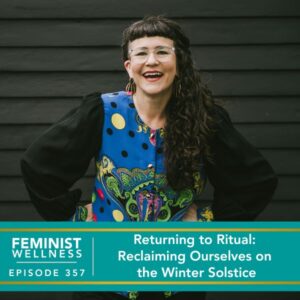
Ep #357: Returning to Ritual: Reclaiming Ourselves on the Winter Solstice
How much time do you spend managing other people's emotions? You know what I mean – smoothing over conflict at family dinners, tiptoeing around your partner's mood, or endlessly reshuffling your schedule for coworkers. It's exhausting. But what if reclaiming your energy could be as simple as lighting a candle?
I know it sounds too easy. Maybe even a little witchy woo. But here's the truth: rituals like this aren’t just nice. It’s necessary for your nervous system.
Join me this week as I explore why so many of us have lost touch with ritual, share examples of practical rituals that create profound shifts, and explain how reclaiming it might be one of the most practical, revolutionary, and feminist things you can do in your healing journey.
My new book, End Emotional Outsourcing: How to Overcome Your Codependent, Perfectionist, and People-Pleasing Habits is here! This book is your practical, science-backed, loving guide to finally stop handing your emotional life over to other people and stop taking theirs on for them. Order yours today by clicking here!
Key Takeaways & Timestamps:
[00:00] – What Ritual Really Is
Why ritual is not woo or performative, but a grounded practice of meaning-making and self-connection.
[02:47] – Why We Lost Ritual
How patriarchy, colonialism, and capitalism dismantled communal and feminine ritual practices.
[06:18] – Ritual and Emotional Outsourcing
How ritual pulls your energy back inward when you are used to scanning, fixing, and caretaking others.
[09:14] – Ritual as Energetic Boundary
Why ritual strengthens self-authority and creates a clear sense of where you end and others begin.
[12:02] – Ritual and Nervous System Regulation
How predictability, sensory input, and repetition help shift the body into ventral vagal safety.
[15:36] – Small Rituals That Actually Work
Simple, everyday rituals that restore presence without pressure or perfection.
[19:01] – Ritual as Choice and Agency
How ritual creates space between stimulus and response so you can act intentionally, not reactively.
[21:22] – Reclaiming Ritual as Self-Possession
Why returning to ritual is a feminist act of self-trust, autonomy, and coming home to yourself.
Listen to the Full Episode:
Episodes Related to Rituals:
Featured on the Show:
• Download my free orienting exercise by clicking here!
• If you have not yet followed, rated, and reviewed the show on Apple Podcasts, or shared it on your social media, I would be so grateful and delighted if you could do so!
• Join me in my group coaching program, Anchored: Overcoming Codependency
• Come join us in The Embodied Learning Lab!
• Get your copy (or 10) of my book, End Emotional Outsourcing!
Full Episode Transcript:
This is Feminist Wellness, and I’m your host, Nurse Practitioner, somatics and nervous system nerd, and life coach Béa Victoria Albina. I’ll show you how to get unstuck, drop the anxiety, perfectionism, and codependency so you can live from your beautiful heart. Welcome, my love, let’s get started.
Hello, hello, my love. I hope this finds you doing so well. What a delight to be here together, as always. And today, on the almost eve of the winter solstice, and today on the almost eve of the summer solstice, we're talking about something that might feel a little witchy and a little woo, which I personally think are beautiful things. And also conveniently, because it's me. we're diving into is both ancient wisdom and cutting-edge nervous system science. We are talking about ritual.
We're talking about ritual. Ritual is a thing I absolutely love. And so what I want to talk about today is why so many of us have lost touch with ritual in our lives. What that loss has cost us and how reclaiming it might be one of the most practical, revolutionary, and feminist things you can do in your journey to heal from emotional outsourcing.
So get comfortable, maybe light a candle if you want, and let's talk about coming home to ourselves. Picture this with me for a second, a long table with flickering candles, a centerpiece of local greens, fragrant and alive, evergreen boughs, stretching across its length. Around this table sit women, faces glowing with shared laughter and quiet reverence, holding space for each other. They pour tea, speak truths, and let the silences breathe. It's not a church service or like a corporate workshop, but something older than either of those. It's a ritual.
In the modern world, many of us have fully lost touch with ritual, those sacred acts of gathering, intention, and meaning-making. And my angels, this loss hasn't been accidental. It's been by design. The patriarchy, white settler colonialism, in late-stage capitalism thrive on isolation, disconnection, and the myth of rugged individualism. These forces convince us that ritual, especially those led by women, especially those that center the everyday sacred, are a problem. They're superstitious, they're frivolous, they're outdated, they're woo, and woo is really bad. But I'll tell you what's outdated. Living a life where you feel untethered from yourself, your body, your consciousness, your spirit, your community. So in this, the week of the winter solstice, so in this, the week of the summer solstice, let's light a candle for the return of ritual and explore why it's not just quaint tradition. Ritual is a profound, practical, like I said, revolutionary and deeply feminist tool for healing.
So to understand the power of ritual, we have to reckon with why it was taken from us. Rituals, particularly communal ones, were once the heartbeat of our lives, our communities, our villages. From solstice feasts to coming of age ceremonies to small daily practices like kneeling in the garden at sunrise. Ritual once tethered us to the rhythms of the earth, of nature, pachamama, of each other and ourselves. But as patriarchal colonialist and capitalist systems took hold, they systematically dismantled communal practices that centered on collective well-being and spiritual self-determination. Rituals were dismissed as women's work, and women's work was dismissed as trivial. Gatherings became suspect because women sharing stories and wisdom and care, that's dangerous. Ooh, that reminds me to talk about when gossip became a sin. Oh, we need a whole show on that, that's coming.
You're not expecting me to be like pro-gossip, we'll get into the details of it, yeah? Because when we gather, we build solidarity, and solidarity, ooh, kryptonite to oppressive systems. These forces also told us that rituals needed to belong to a sanctioned religion, to have value, importance, or legitimacy. If you weren't lighting incense in a church or temple, didn't count. And so secular rituals, those moments of quiet meaning-making in the everyday, fell out of favor, leaving many of us adrift, especially those of us who feel discomfort or alienation with an organized religion. Rituals are more than actions. They're containers for energy. Yours, mine, ours. Energetically, a ritual is a gathering point. It focuses and channels the scattered, frantic hum of modern life into a singular moment of alignment.
Think of it like closing 50 browser tabs on your mental desktop and opening just one full screen with clarity and intention. When we create ritual, we step into a moment of deliberate energetic presence. We tell the world and ourselves, this matters. And in so doing, we reclaim a vital force. that emotional outsourcing tends to drain our attention. Attention is energy. When you pour it out indiscriminately, anticipating someone else's needs, reading their moods, trying to fix, smooth, or anticipate, or doomscrolling to buffer against your feelings, you're left depleted. But in ritual, you reverse that flow. You stop scattering your energy outward and draw it back inward like a tide returning to shore. This isn't abstract and it needn't be overly esoteric. It's visceral.
As you light a candle, breathe deeply, or arrange flowers on a table your body knows. This is for me. You're filling your own energetic well, creating a moment where your energy aligns with your deepest intentions. Ritual also creates a feedback loop of energetic reciprocity. The time and care you invest in ritual come back to you. Not in grand mystical ways, though I'm not ruling those out, but in grounded practical ones. The act of pausing to light a candle before a difficult conversation might return to you as a calm heart and a clearer mind. The energy you devote to journaling by moonlight might return as a sudden illuminating insight during the next week.
Ritual has a way of taking the energy we give it and returning it, amplified, clarified, and attuned to our needs. Let me address something here because I know what some of you are thinking. You're thinking something along the lines of, I don't have time for this, I don't have money for fancy candles and special containers and all of that. I hear you, I hear you. Here's what I want you to consider. What else are you giving your time away to? How much time do you spend fretting over what someone meant when they said what they said? How much energy goes into replaying conversations, analyzing tone, worrying about whether you upset someone who says, oh, no, I'm fine, managing their moods instead of staring at moon, making art, brushing your hair a hundred times.
Or even simpler, how much time goes into buffering, which we've talked about in episodes 14, 105, and honestly like a dozen more over the last five years. You know, buffering. That thing we do to not feel our feels. The scrolling, the online shopping, the binge-watching, the overeating, the overworking, the overexercising. Here's the thing. Ritual doesn't have to be expensive or time-consuming. It certainly it wasn't for your great-great-great-grandmothers. We're talking about three breaths when you wake up, a candle from the grocery store, using a mug you already own to drink your coffee slowly.
The question isn't whether you have the time or money, the question is whether you're willing to redirect the energy you're already spending on everything and everyone else back towards yourself. Energetically, ritual is also about boundaries. Emotional outsourcing blurs the boundaries between you and them. It's a constant leakage of your energy into other people's needs, feelings, and expectations. Ritual, by contrast, fortifies your energetic container. It says, this is my space, my energy, my time, and yeah, maybe I only have three minutes or three breaths on this given Wednesday, and today I'm setting the intention to turn towards myself more and more often because I'm learning that it's okay for me to matter in my life.
When you light a candle for yourself or draw a bath with intention, you're not just engaging in self-care. You're reclaiming energetic autonomy, self-authority, and agency. You're marking out a sacred boundary. Here is where I end and the world begins. And this is particularly important for us who've spent years in people-pleasing and perfectionist loops where saying no felt impossible. Ritual becomes a quiet and radical act of self-possession, a way to claim the right to your own energetic resources without apology. Here's the thing about ritual. It doesn't need to be elaborate or like Instagram worthy to matter. In fact, the quieter, the more personal the ritual, the simpler, the more powerful it can be. A ritual can be as easy as pausing before you sip your cup of tea to say thank you, body, for carrying me through this life, or taking three breaths when you wake up to whisper, I belong to myself. These small acts, they're energetic pivots. They shift you out of autopilot and into intentionality, turning ordinary moments into sacred ones.
In a world that tells us we need to earn sacredness through productivity, morality, or adherence to external rules, these small personal rituals are an act of defiance. They declare that sacredness, importance, is not bestowed by systems or institutions. It's something you create moment by moment with your own hands, your own heart, your own breath. Ritual matters energetically because it reminds us that we are not just cogs in a machine or vessels for others' needs. We are vital, dynamic beings connected to rhythms far older and deeper than any spreadsheet or to-do list. Ritual reconnects us to those rhythms, the cycle of nature, the pulse of our breath, the quiet hum of aliveness that exists beneath the noise.
Let's get nerdy because you know I love a good science-backed deep dive. So ritual isn't just nice, it's necessary for our nervous systems. The magic of ritual lies in its ability to help us regulate our physiology. Here's how. Rituals create predictability. Whether it's lighting a candle, saying a mantra, bowing your head to the universe and creation before a meal, or preparing tea in a special way, these repeated actions signal to the brain, you're safe now, or safe enough now. Predictability is a key feature of regulation and co-regulation, which allows us to shift out of fight-or-flight and into a ventral vagal state, a state where connection, creativity, and choicefulness live. And if not for choicefulness, why else are we doing this work?
So when we engage in ritual, we move out of ruminative loops—hello, emotional outsourcing—and into embodied awareness. The small sensory details—so a candle's flicker, the softness of a blanket during a winter journaling practice, or the sunlight on your face during a summer solstice practice, anchor us in the present moment. This is especially vital for those of us who've spent years outsourcing our emotional well-being to others, which often keeps us stuck in hypervigilance, people-pleasing, and defaulting to their opinion far over our own.
Ritual helps us practice intentionality, which is the cornerstone of agency or choice. When we take even five minutes to craft a ritual, whether it's setting the table for ourselves as if honored guests, or writing a gratitude list at the end of a long day. And side note, we do three gratitudes before bed, Billey and I, every single night. It is such a beautiful practice. And it's never about like positive vibes only or positive washing. No, no, we talk about what's lousy too, but the last thing we do before bed, before we say goodnight, I love you, is three things we're grateful for. And wow, it is so amazingly supportive. And through this kind of work, we reclaim that power of choice, which is the antithesis of emotional outsourcing, which as we know, thrives on being unintentional, on automatic reactive habits that serve others' needs over our own.
Emotional outsourcing teaches us to believe a devastating lie, that our worth is defined by how we seamlessly manage, soothe, and anticipate the needs of others. Whether it's smoothing over conflict at family dinners, endlessly reshuffling our schedules for coworkers, or tiptoeing around a friend's mood or a partner's mood, emotional outsourcing locks us into a cycle of external validation and internal depletion. It's exhausting, unsustainable, and most painfully, It pulls us away from our capital S self.
Ritual, by contrast, creates a radical shift. It says, hey, you, your needs matter, and your presence matters. You are worthy, not for what you do, but simply for who you are. And so when you commit to a ritual, you're breaking that cycle. You're carving out space to reconnect with yourself and your own desires, space that emotional outsourcing would otherwise fill with guilt, with obligation, and over-functioning. Through ritual, you step off the hamster wheel of busyness, caretaking, fixing, performing, and you begin to hear the quieter truths of your own heart. This is where the magic happens, loves. Not in what you do for others. others, but in how you return to yourself. Let's dig into why this should work. Let's dig into why this should work. fix, sacrifice yourself for someone else's comfort. Do it quick, do it fast. Ritual, on the other hand, cultivates intentionality.
When you engage in ritual, you practice pausing. You ground yourself in a present moment act of meaning making for your own life. And in that pause, you create a gap between stimulus and response. A space to ask, what do I want? What do I need? And that gap is where choicefulness lives. It's where you begin to reclaim your autonomy and agency. The very thing is emotional outsourcing strips away.
Here's the subtle but transformative shift ritual makes possible. Instead of reacting to life, scrambling to meet your mom's expectations, and smoothing over your partner's bad mood once again, or rearranging your day for a colleague, you start responding. You begin to see the patterns of emotional outsourcing for what they are, well-worn grooves of survival thinking, rooted in your nervous system's attempts to keep you safe by prioritizing others. But my love, survival is not the same as thriving, and you are not that same child who had to put others ahead of them to simply get through. You get to update those internal narratives to meet the life you are living and want to step into living.
When you practice ritual, you gently interrupt those old grooves, those old patterns. Anchoring yourself in ventral vagal state, the place of calm connection and intentionality, allows you to choose your response rather than defaulting to old automatic patterns so you can decide what you want to do next, how you want to meet life, and what you actually want to take on day by day. And my beauty, this isn't selfishness, it's self-possession. It shifts the focus back where it belongs, on you, your values, and your capacity to live in alignment with them. And it's not easy work. Emotional outsourcing often feels like second nature, especially if you've spent years or decades perfecting it. But every time you choose to light a candle instead of jumping into savior mode or make a cup of tea instead of smoothing over someone's mess, you're rewriting those patterns. You're teaching your nervous system it's safe to prioritize yourself.
And the beauty of ritual is that it grows with you. What starts as a quiet personal practice, a single act of grounding and self-connection ripples outward. Over time, you'll notice how ritual strengthens your self-trust, making it easier to say no, to set boundaries and to honor your own needs. Each ritual becomes a microcosm of the larger shift away from emotional outsourcing and towards agency, choicefulness, and intentionality. Because ritual is, at its core, about returning to yourself, and from a grounded sense of self, you can be a part of the interdependent whole.
You can give back to your communities, because you're not living from the old blame and shame, the old guilt, the old resentment, the old tit-for-tat. rewrites the story of who you are and what you deserve and through this rewriting this reclaiming you can step out of emotion outsourcing it into your truest fullest self. So before I share some example rituals some remedies a little note from past me.
So my love let's go through some extremely simple easeful rituals that you can incorporate into your life today no matter how busy you are. The ones we mentioned are place both feet on the ground when you wake up, take three breaths, and whisper something that feels supportive to you. So studies show that affirmations for affirmation's sake do not work. But when we believe those affirmations because they're rooted in your values, that's when they can actually change our brain chemistry. Freaking love science.
So I started years ago with, “I belong to me,” and that felt really supportive because it was in alignment with my values of agency, autonomy, interdependence, right, everything I was working to really embody. But if that doesn't work for you, take some time to sit with yourself and to ask yourself, what would be most supportive? And it can really, like a phrase doesn't need to come to you, you can just pause, hand to heart, take three breaths, and then stand up and get to your day. So this three second ritual reminds you to come back to yourself before the world starts asking things of you, before you grab your phone, before the kids even know you're awake, before the dog is demanding a walk. Three breaths.
Light a candle after the kids are asleep. Write down three moments from the day that made you feel alive. And if you've been writing all day, just hand on your heart, name them in your mind. Yeah, and if you have a partner or a friend or a roommate you can name them with even better. This small act of naming aliveness brings you back to yourself.
On the solstice, gather some natural objects, a pine cone, a stone, a sprig of rosemary or lavender, whatever grows locally for you, and place them in a small bowl. As you hold each item, say one thing you're grateful for this season. This practice helps you connect to the earth and your own sense of abundance. Before a challenging family dinner, create a ritual for grounding. Stand in front of a mirror, orient, place your hands on your heart and say, I will do my best to honor my needs. So listen to the language, not, I will 100% be the most bestest at honoring my needs. Are you going to believe that? I wouldn't. I'm going to do my best to honor my knees. Yeah, kitten steps, right?
So this small ritual helps fortify your self-trust and creates a felt sense of safety in your body. Another favorite is to choose a mug that feels special. Special doesn't mean expensive, but a mug that feels special. Prepare a cup of tea or coffee, slowly and intentionally. Let it steep, smell it, feel the weight of the mug, feel the heat of it. I'm actually going to hold my mug as I do this, yeah? Take a moment and really feel the warmth, the smell of the tea. And then as you sip, I am learning to believe I am worthy of care. Hey, listen, if you're already at, I'm worthy of care, go for it, do it. But I just want to give you a kitten step to it. I am learning to believe that it is possible that I am worthy of care. And this act of, tiny sweet act of somatic presence reminds your nervous system that it is possible to begin to believe that you are safe and deserving of care. Yeah?
The beauty of ritual is it doesn't require any kind of belief system, any fancy tools, anything much, just intention. When we gather pine cones, write in journals, stand barefoot in the snow or on the sand, we're not just doing something quaint or poetic, though we are doing those things. We're repairing our connection to ourselves, our bodies, the earth, humanity, all our creations. Ritual is an anchor in a world that asks us to drift. It's a rebellion against the forces that tell us we must do more, be more, and give more to others to be worthy. It's a reminder that we belong to ourselves first and foremost.
This solstice, I invite you to light a candle and step into your own ritual. Let it be messy, let it be simple, let it be complicated, let it be a thousand steps or just the one, but let it be yours. Because when we reclaim ritual, we reclaim ourselves. And that, my love, is the most sacred act of all.
Thank you for listening, my darling. Let's do what we do. Gentle hand on your heart should you feel so moved. And remember, you are safe, you are held, You are loved, and when one of us heals, we help heal the world. Be well, my beauty. Mwah, ciao ciaos. I'll talk to you soon.
Enjoy the Show?
• Don’t miss an episode, listen and follow on Apple Podcasts, Spotify, or RSS.
• Leave a review in Apple Podcasts.
• Join the conversation by leaving a comment below!